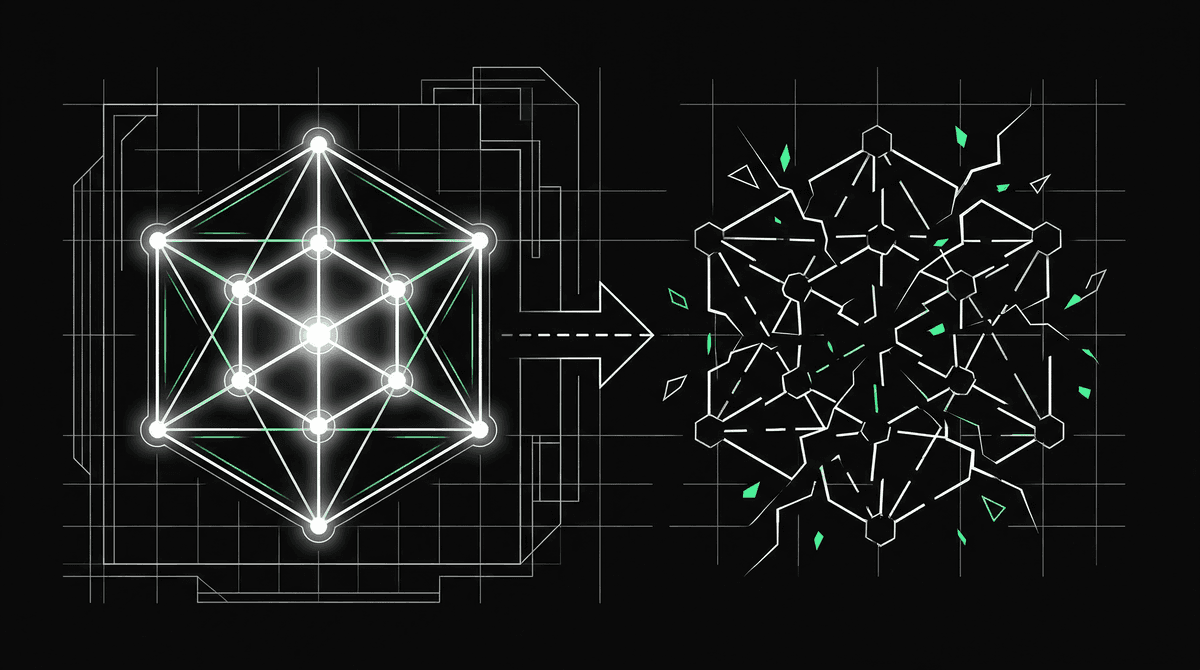
Why Your AI Demo Works and Your Production System Doesn't
Your demo impressed the board. Your production system is bleeding money, hallucinating answers, and breaking on edge cases nobody tested. The model isn't the problem.
Your AI demo killed it. The board loved it. The CEO sent a Slack message with three fire emojis. Someone said "game-changer" without irony. You had a curated dataset, a happy path, and a model that performed like a trained seal at SeaWorld.
Thirty days into production, the seal is biting customers.
The system hallucinates answers that sound right and are dangerously wrong. Costs are 50x what you projected. Edge cases you never imagined are now your daily standup agenda. And the model, the thing everyone blamed, is working exactly as designed. It's everything around it that's on fire.
This is the pattern. Not once. Not twice. Nearly every AI system I've seen go from demo to production hits the same wall. The model isn't the problem. The engineering is.
Curated inputs. Happy path. Board-ready.
The happy path is a lie
Demos work because they're rehearsed. You pick the inputs. You know the outputs. The context window has 2,000 tokens because you gave it a clean, short prompt and a tidy document.
Production doesn't work that way. Users paste in 47-page contracts. They upload scanned PDFs with coffee stains. They ask questions in broken English, Hinglish, or a dialect your training data has never heard. The context window that was comfortably at 2K in the demo is now pushing 150K, and the model is quietly dropping critical information from the middle of the window because that's what LLMs do when you overload them.
The context window isn't a bucket you fill. It's a spotlight. It lights up the beginning and the end, and everything in the middle gets progressively dimmer. Your demo never exposed this because your demo never had real-world input volume.
Cost blowouts from laziness
The demo used GPT-4o for everything because it was easy. Classification? GPT-4o. Summarization? GPT-4o. Extracting a date from an email? GPT-4o. It worked great at 50 requests a day during testing.
At 50,000 requests a day in production, that laziness costs you $12,000 a month. The classification task that GPT-4o handles with a sledgehammer? GPT-4o-mini does it at 1/20th the cost with identical accuracy. The date extraction? A regex would have been fine. You used a $15/million-token model to do what a three-line function could handle.
This isn't a cost problem. It's an engineering problem. Cost routing, choosing the right model for each task, is a system design decision. Nobody makes it during the demo because there's no incentive to. The bill is small. The audience is impressed. The reckoning comes later.
Hallucinations aren't edge cases
In the demo, the model hallucinated once. The team laughed it off. "It said the document was from 2019 instead of 2020. We'll add a validation step." Everyone nodded. Nobody added the validation step.
In production, hallucinations aren't funny. They're liability. A healthcare AI that confidently fabricates a drug interaction. A legal AI that cites a case that doesn't exist. A financial AI that invents a compliance requirement. These aren't theoretical scenarios. They're Tuesday.
The fix isn't better prompting. The fix is engineering. Retrieval verification. Source citation with links users can check. Confidence scoring. Output validation against known schemas. Guardrails that reject responses when the model's uncertainty is high. None of this is model work. All of it is engineering work. All of it gets skipped in the demo.
Compliance is invisible until it isn't
Your demo didn't have a compliance layer because your demo wasn't in production. Nobody asked "does this output comply with HIPAA?" during the board meeting. Nobody checked whether the model was retaining PII in its context. Nobody verified that audit logs existed.
Production in regulated industries needs all of this on day one. Healthcare has HIPAA and FHIR. Finance has SOX and PCI-DSS. Legal has privilege rules and jurisdiction-specific requirements. These aren't features you add later. They're architectures you design from the start.
I've watched teams spend three months building an AI feature and six months retrofitting compliance. The ratio should be inverted. If you're in a regulated industry and your compliance architecture isn't designed before the first prompt is written, you're building debt that compounds daily.
Edge cases from undocumented reality
The demo handled five document types. Production encounters forty-seven. Including scanned faxes from 1998. Including handwritten notes someone photographed at an angle. Including a spreadsheet where the user merged every cell because they thought it looked nicer.
This is the process complexity gap. Businesses don't run on clean data and standard formats. They run on decades of accumulated habits, workarounds, and "we've always done it this way." That tribal knowledge isn't in any documentation. It's in the heads of people who've been there for fifteen years, and nobody thought to interview them before building the AI system.
The gap between the API call and production
Here's what a demo needs: an API key, a prompt, and a prayer.
Here's what production needs:
- Context management that doesn't overflow the window
- Model routing that matches task complexity to model capability
- Hallucination detection and output validation
- Compliance guardrails specific to your industry
- Cost monitoring with automated alerting
- Latency optimization for user-facing responses
- Error handling for model failures, rate limits, and degraded responses
- Eval pipelines that measure accuracy on your actual data
- Edge case documentation from the people who know the process
- Monitoring dashboards that show what's actually happening
That's not a model problem. That's ten engineering problems wearing a trench coat pretending to be an AI problem. And every single one of them is invisible during the demo.
Why this keeps happening
Teams treat AI deployment like software deployment. Ship the feature, monitor the metrics, iterate. But AI systems have a property that traditional software doesn't: they're non-deterministic. The same input can produce different outputs. The failure modes are unpredictable. And the system's behavior changes based on input patterns you can't fully anticipate.
This means the engineering around the model matters more than the model itself. The orchestration layer. The validation layer. The monitoring layer. The compliance layer. The cost optimization layer. Strip all of these away and you have a demo. Add them all and you have a production system.
The gap between those two things is where AI projects live or die. And it's an engineering gap, not an AI gap.
The model works. It always worked. Build the system around it that works too.