What's Commoditizing in AI (And What Never Will)
Every developer with an API key is now an 'AI studio.' Here's the commoditization timeline for AI services, and why knowing the difference between commodity and engineering is the only positioning that matters.
Six months ago, building a chatbot was a $15K consulting engagement. Today it's a weekend project with Claude and a YouTube tutorial. Six months from now, multi-agent orchestration will follow the same path. The commoditization clock runs faster than most AI studios want to admit.
I track this because my business depends on knowing which side of the line I'm standing on. Here's the current map, built from market data, client conversations, and watching what's actually happening to pricing.
Already commodity
These were premium 6-12 months ago. Now anyone can do them:
- Chatbot building. Claude/GPT + any framework = working chatbot in hours. The YouTube tutorials are better than most agencies' output.
- Workflow automation. n8n, Make, Zapier + AI = weekend project. No engineering required.
- Speed-to-lead agents. Fully templated. Multiple no-code platforms offer this out of the box.
- Content generation. Every tool does this. Competing here is competing on nothing.
- Basic RAG implementations. Standard pattern. Well-documented. A junior developer ships this in a day.
- Code generation and app scaffolding. Cursor, Claude Code, Replit Agent, v0, Bolt. The tools ARE the service.
- Simple API integrations. Connect AI to CRM/ERP. Template work.
If your AI studio's primary offering is on this list, you're competing with tools that cost $20/month. The margin is already gone.
Commoditizing now (6-12 months)
Premium today, but the window is closing:
- Multi-agent orchestration. Frameworks are proliferating (CrewAI, AutoGen, LangGraph). Still premium because most teams can't do it well. But "most teams" is changing fast.
- Voice AI agents. ElevenLabs + Groq + any framework. Getting measurably easier every month.
- AI-powered analytics dashboards. Tools like Hex and Mode are adding native AI. The custom consulting window is closing.
- AI strategy slide decks. The era of the 100-page PDF as a deliverable is dead. Clients want working prototypes, not frameworks.
- Generic AI training workshops. YouTube is free. "Intro to AI for your team" is worth nothing.
Still premium (hard to commoditize)
These stay valuable because they require things tools can't provide:
- Enterprise data readiness and governance. Messy, political, requires understanding the organization, not just the technology. 80% of companies have AI-unready data.
- Legacy system integration. Each one is unique. Requires deep technical AND domain knowledge. You can't template a system that was built over 15 years of accumulated business rules.
- Vertical AI with proprietary data. Can't copy 20 years of domain data. A trading pattern engine with 2,500 analyzed days isn't something you build from an API key.
- AI safety and compliance for regulated industries. Healthcare, finance, legal. FHIR compliance, ABHA integration, financial reporting standards. Certification matters. Mistakes have legal consequences.
- Production engineering after the API call. Context architecture across 49 modules. Cost-optimized multi-model routing. Medical data guardrails. Eval pipelines that quantify reliability before deployment. This is where "I know the API" meets "I know what breaks."
- Change management and adoption. The human side. Tools can't fix organizational resistance. Trust ladders, confirmation flows, progressive autonomy design.
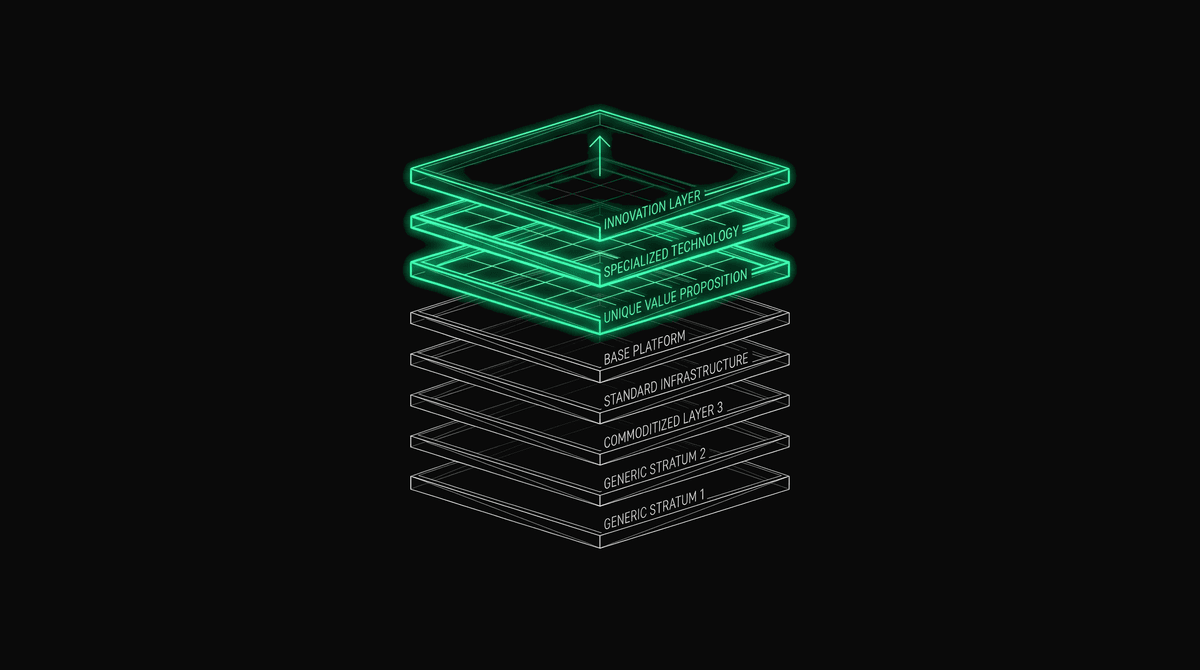
The split happening right now
The market is bifurcating in real-time:
Layer 1 (Implementation): Dying. Margins compressing to near-zero. Tools doing this work for $20/month subscriptions. McKinsey shrank from 45,000 to 40,000 employees. Entry-level consulting salaries frozen for three consecutive years. Freelance marketplace spending collapsed from 0.66% to 0.14% of company budgets.
Layer 2 (Vertical Intelligence): Growing. VC funding flowing to vertical AI (50-53% of all venture capital in 2025). Specialized products achieving 85% net revenue retention vs. 32% for generic wrappers. Domain expertise + proprietary data = the only moat tools can't eat.
The AI wrapper apocalypse is real. SimpleClosure reports a 2.5x increase in Series A shutdowns, with AI wrappers "catastrophically over-represented." Google's VP called it: LLM wrapper companies face "existential threats." 95% of generative AI pilots fail to deliver measurable ROI.
How to tell which side you're on
Ask one question about your service: "Could a smart developer with Claude and a weekend replicate this?"
If yes, you're selling a commodity. Your margin will compress to zero within 12 months regardless of how good your sales copy is.
If no, ask why not. The answer is your actual moat. It's usually one of three things:
- Proprietary data that compounds with use. Every interaction makes the system smarter. Competitors would need to rebuild the entire history.
- Domain expertise encoded in a system, not a slide deck. Not "I know finance." Rather: "I built a pattern engine over 2,500 analyzed trading days with real conversion data."
- Trust and accountability. A subscription fee can be an insurance premium. Clients pay for liability assignment, SLAs, someone to call when things break at 2 AM. AI can't provide this.
The clock is running. The line between commodity and engineering only moves in one direction.