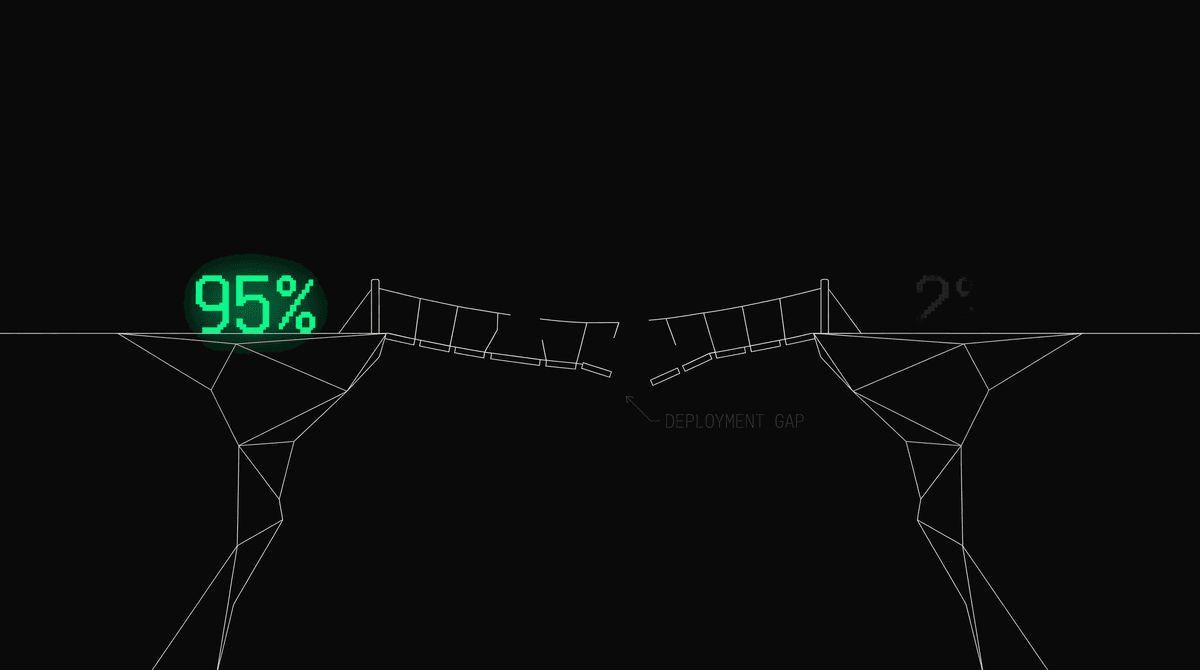
The Deployment Gap: What Anthropic's Data Actually Says
94% feasible. 33% deployed. Everyone quotes the headline. Almost nobody has read the paper. Here's what the data actually shows, occupation by occupation, and why the gap stays wide.
Everyone's quoting the same number. 94% of technical work is AI-feasible. It shows up in pitch decks, LinkedIn posts, conference talks. It's become the new "software is eating the world." A thing smart people say to sound informed.
Almost nobody has read the actual paper.
Anthropic's 2025 Economic Index isn't a survey or a prediction. It's built on something no previous AI labor study had: real usage data from millions of Claude interactions, matched against 800 US occupations from the O*NET task database, then validated against Bureau of Labor Statistics employment projections.
The result is a metric called "observed exposure." Not what AI could theoretically do. What AI IS doing. And the gap between the two is where the entire story lives.
The numbers everyone misses
97% of what people use Claude for falls within theoretical capability. But that 97% covers only a fraction of the total task landscape. People use Claude heavily for the tasks it's good at. They don't use it at all for most other tasks in their occupation.
Here's where Claude's compute actually goes:
- 68% on tasks an LLM can handle alone
- 29% on tasks needing additional tools
- 3% on tasks classified as not feasible
Now look at the top 10 most AI-exposed occupations:
| Occupation | Observed Exposure |
|---|---|
| Computer programmers | 74.5% |
| Customer service reps | 70.1% |
| Data entry keyers | 67.1% |
| Medical record specialists | 66.7% |
| Market research analysts | 64.8% |
| Sales reps (wholesale/mfg) | 62.8% |
| Financial analysts | 57.2% |
| QA analysts & testers | 51.9% |
| InfoSec analysts | 48.6% |
| Computer support specialists | 46.8% |
Look at that list carefully. It's not all software. Customer service at 70.1%. Medical records at 66.7%. Sales reps at 62.8%. These are departments that exist in every company. Every business has a support team, a sales floor, an analyst pool. AI is already replacing large chunks of what they do. Most businesses just don't know it yet.
And 30% of all workers have zero observed AI exposure. Cooks, mechanics, lifeguards, bartenders. Physical, in-person work. AI hasn't touched them.
The radar chart nobody talks about
This is the most important data in the entire paper. Theoretical AI coverage vs. observed coverage, by occupation category:
| Category | Theoretical | Observed | Gap |
|---|---|---|---|
| Business & Finance | 98% | 35% | 63% untouched |
| Computer & Math | 94% | 33% | 61% untouched |
| Management | 90% | 20% | 70% untouched |
| Office & Admin | 88% | 28% | 60% untouched |
| Legal | 85% | 10% | 75% untouched |
| Architecture & Engineering | 82% | 18% | 64% untouched |
| Education | 78% | 8% | 70% untouched |
| Healthcare practitioners | 55% | 5% | 50% untouched |
In every single knowledge work category, the majority of work that AI could be doing is not being done by AI.
Here's the thing most people miss: Computer Programmers (single occupation) are at 74.5% coverage. But the entire Computer & Math category is at 33%. Why? Because "Computer & Math" includes systems architects, database administrators, network engineers, project managers, security specialists. Pure coding is heavily automated. Everything else around it barely is.
That pattern repeats everywhere. The most automatable single task gets picked up fast. The rest of the occupation stays untouched.
The software developer paradox
The paper includes a scatter plot: AI exposure vs. projected employment growth (2024-2034). The overall trend slopes down. More exposure correlates with less growth.
But software developers are the biggest outlier on the chart: 28% exposure with +16% projected growth. The most positive outlier in the entire dataset.
Why? Because the demand for software is growing faster than AI can replace developers. AI makes each developer more productive, but the total market for what developers build is exploding. Every business needs custom AI integrations, automation workflows, agent systems. The pie is growing faster than the slices are getting more efficient.
The zero-skill person goes from 0 to 1 with Claude. The expert goes from 8 to 80. Both effects are real. But the market rewards the 8-to-80 multiplier at a premium.
Who actually gets hurt
The demographics data reveals something nobody's discussing:
The most AI-exposed workers earn $32.69/hr (47% more than unexposed workers). They're 54.4% female. 37% hold a bachelor's degree. Average age 42.9. More likely married.
AI is not eating the bottom of the labor market. It's eating the educated, well-paid middle. The people losing tasks to AI earn $65-70K/year, have degrees, and are in their early 40s.
And the employment data shows no mass layoffs. Unemployment rates for exposed workers haven't changed since ChatGPT launched. But for workers aged 22-25, job-finding rates in AI-exposed occupations dropped 14%. Companies aren't firing experienced workers. They're just not hiring junior replacements.
Why the gap stays wide
If AI can handle 60-98% of knowledge work tasks, why is it only doing 5-35%? Four forces hold it open:
The design gap. Models are far ahead of value delivery. Give people a chat box that can do unlimited things and they'll ask for a dad joke. The interface limits utilization. We're in the "tiny web page on mobile" phase of AI UX. The paradigm shift hasn't happened yet.
The trust gap. Show users 1,000 steps of what the agent did: "Why are you telling me all this?" Show them nothing: "I don't trust it." Trust builds on a ladder, interaction by interaction. Most organizations are stuck on step one. And managing 50 AI agents asking 50 questions a minute is a problem nobody's designed for.
The process complexity gap. Businesses aren't isolated tasks. They're interconnected processes. A task that's 100% automatable in isolation might be 20% automatable when it involves compliance review, management approval, and cross-department coordination. Edge cases from decades of accumulated rules aren't documented anywhere. You can't automate what you don't know exists.
The pricing gap. Even when AI works, organizations can't figure out how to pay for it. Per-seat collapses when AI does the work. Consumption-based scares customers. Outcome-based creates diminishing returns. Companies freeze and watch instead of deploying.
What this means
The deployment gap isn't closing on a technology timeline. It's closing on a human timeline. Design paradigms, organizational trust, process mapping, pricing models. These change at the speed of institutions, not the speed of model releases.
That's good news if you're building in this space. The window is wider than the "AI moves fast" narrative suggests.
And the opportunity is specific. Not "AI for everything." But: which of your processes are input-constrained (optimize for efficiency) vs. output-constrained (optimize for creativity)? Which of your tools are vulnerable to AI displacement vs. safe? Where on the trust ladder are your teams?
The gap isn't a problem to solve once. It's a landscape to navigate. And most businesses are standing at the edge of the map, staring at territory they know exists but can't see clearly.
That's where we work.