SaaS Is a Filing Cabinet: Why AI Eats Software From the Inside
The entire history of software from 1960 to 2022 was one move: take a filing cabinet, turn it into a database. Now the filing cabinet can do work. What dies, what survives, and what grows.
Alex Rampell (a16z General Partner) makes a claim that reframes the entire software industry:
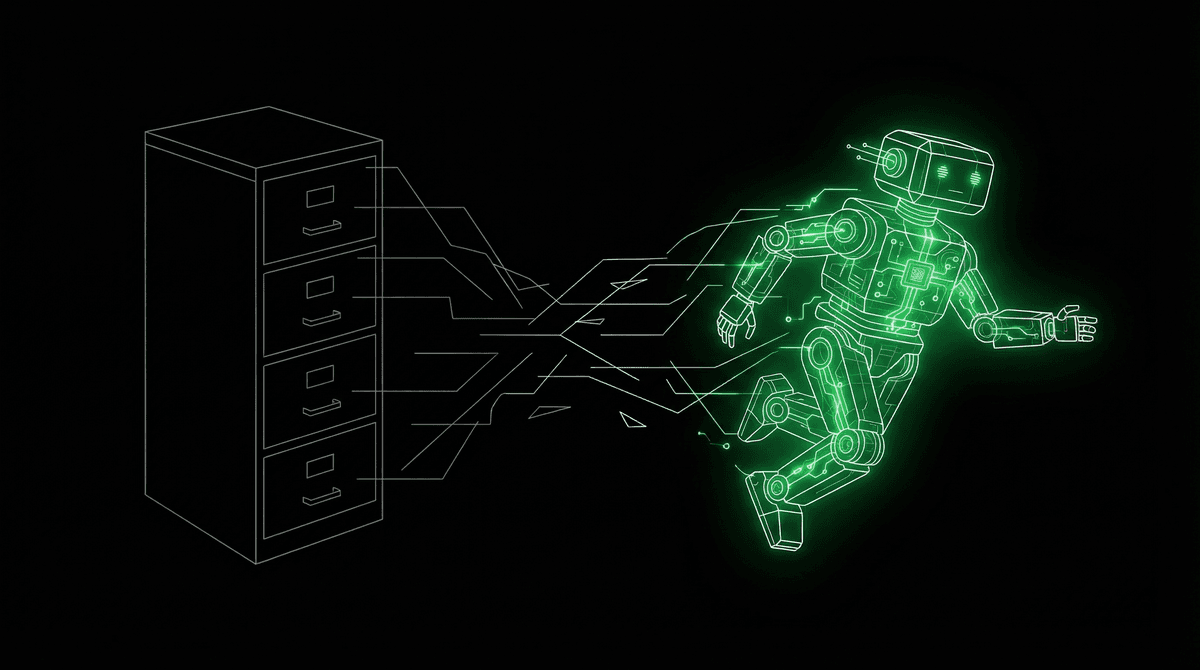
The entire history of software from 1960 to 2022 was one move. Take a filing cabinet. Turn it into a database. That's it. Every SaaS product. Every enterprise system. Every startup. They all did the same thing: digitize a filing cabinet.
Saber Systems (1960, IBM + American Airlines): paper flight records -> database. MOPS (Mass General Hospital): paper medical records -> database. ACT! (1987): paper contact cards -> CRM database. Workday, Salesforce, Zendesk, HubSpot. All filing cabinets that became databases.
The AI shift: the filing cabinet can now do work. Not just store data. Act on it.
Three Types of SaaS Companies
The public market lumps all SaaS together. That's a mistake. There are three fundamentally different categories, and AI affects each differently:
Type 1: Seats Tied to Work (VULNERABLE)
Example: Zendesk. Every seat is a customer service agent producing work — answering tickets, resolving complaints. The seat IS the labor.
If AI does the work, seats go to zero. Revenue goes to zero. Not because the product is bad. Because the product's pricing model is attached to the labor it replaces.
But here's the flip: if Zendesk pivots to outcome-based pricing (pay per resolved ticket instead of per agent seat), revenue could triple. Because AI resolves tickets faster, cheaper, and 24/7. The volume of resolvable tickets goes up. The cost per ticket goes down. Total value delivered goes up.
Type 2: Seats as Pricing Trick, Not Tied to Work (SAFE)
Example: Workday. Charges per employee in the organization. But employees aren't using Workday to produce work. HR uses it. Payroll uses it. The per-employee charge is a pricing metric, not a labor metric.
GE has 340,000 employees and pays Workday per head. Those employees don't open Workday. They get paid through it. The pricing feels FAIR because it scales with company size, not with usage.
Nobody's going to vibe-code their own Workday. The Atlassian CEO said it best: "The idea I would vibe code my own Workday and then run it is terrifying." These systems encode decades of regulatory compliance, multi-country payroll rules, benefits administration. The accumulated edge cases are the product.
These SaaS companies ADD AI capabilities — Workday gets smarter, surfaces insights, automates approvals. They don't get replaced by AI. They get enhanced by it.
Type 3: In Between (MIXED)
Example: Adobe, Salesforce. Some seats produce work (designers using Photoshop, salespeople logging calls). Some don't (executives reading dashboards).
The front-end experience (where humans interact) can be divorced from the back-end system of record (where data lives). AI might replace the front-end interaction. The back-end data platform persists.
Alex Rampell at a16z: "We have 600 Salesforce licenses. I never log in. But I use the output constantly." The system of record survives. The seat-based interaction layer may not.
The Edge Case Argument
Alex Rampell's noodle shop analogy is the best argument against "AI replaces all software":
A noodle shop in Japan has operated since 1587. The recipe is public. Anyone can make the noodles. But the accumulated culture of surviving the flour shortage of 1623, the ingredient swap during the war, the recipe modification after a customer allergy — 440 years of edge cases — cannot be replicated by reading the recipe.
The Design Gap
Atlassian CEO Mike Cannon-Brookes delivered the most honest assessment of AI's current impact:
"Give people a chat box that can do unlimited power and they're like, tell me a dad joke."
The models are far ahead of the value they're delivering. The gap is design, not technology.
The trust problem: AI clearing your inbox is terrifying if you don't trust it. Too many confirmation loops = frustrating. Too few = no trust. The right balance is an unsolved design problem.
The input problem: One-shotting is useful but iteration is where value lives. "You changed the thing I didn't want you to change" is the universal AI editing complaint. The interface for precise, iterative control doesn't exist yet.
The 50-intern problem: "The problem with having 50 interns is you get a lot of work done. The problem with having 50 interns is they ask you 50 questions a minute." Managing agents at scale requires management interfaces nobody's designed.
What Dies, What Survives, What Grows
Dies
- Per-seat pricing for work-producing seats
- Simple CRUD applications (below the commodity line)
- Software that stores data but doesn't act on it
- "AI transformation" slide decks (the market wants working prototypes, not PDFs)
- Generic AI training workshops (YouTube is free)
Survives
- Systems of record with decades of embedded logic
- Compliance-critical software in regulated industries
- Platforms that become stickier with AI (extensibility plays)
- Software pricing that adapts to value delivered (outcome-based)
Grows
- AI-native software built from scratch for vertical workflows
- Intelligence layers that sit between general AI and specific business processes
- Outcome-based platforms where pricing = results delivered
- Design tools for human-AI interaction (the 50-intern management problem)
The Extensibility Play
Here's the counter-intuitive finding: AI makes platforms stickier, not more replaceable.
Vibe coding custom applications ON TOP of platforms makes the platform more valuable. Building a custom conference room booking app for the Miami office using Workday data makes Workday stickier. The personal apps increase switching costs.
What This Means for Builders
1. Don't Build Filing Cabinets
The age of "take a manual process, make a database, charge per seat" is over. If your product stores data and displays it in a dashboard, AI will eat you. The dashboard IS the filing cabinet.
2. Build Software That Does Work
The next generation of software doesn't store data. It acts on it. QuickBooks doesn't just record transactions — it categorizes them, flags anomalies, generates reports, files taxes. The filing cabinet became a worker.
3. Encode Edge Cases
The noodle shop survived 440 years because of accumulated knowledge that can't be replicated from public information. Build software that encodes edge cases specific to your domain. Indiana maternity leave rules. IVF clinic trigger shot timing protocols. Gujarat textile export documentation requirements.
The edge cases ARE the product. Everything else is a feature someone can vibe-code.
4. Price for Outcomes
Not per seat. Not per API call. Per result. Per appointment booked. Per ticket resolved. Per report generated. The SaaS companies that survive this shift are the ones that align their pricing with the value AI delivers. The ones that don't will watch their seat count go to zero.
Synthesized from Atlassian CEO Mike Cannon-Brookes and a16z GP Alex Rampell podcast (March 2026), with Sidu Ponnappa's asset/inventory framework applied.