AI Agents Aren't Chatbots — Here's the Difference
Everyone calls their chatbot an 'agent' now. It's not. A chatbot responds to messages. An agent takes actions. The difference is not intelligence — it's architecture. The loop, the tools, the memory, the planning.
Everyone calls their chatbot an "agent" now. It's not.
A chatbot responds to messages. An agent takes actions. A chatbot says "I'd recommend scheduling an appointment." An agent books the appointment, sends you a confirmation, and updates the calendar.
The difference is not intelligence. It's architecture.
The Agent Loop
A chatbot is: input -> response. One pass. Done.
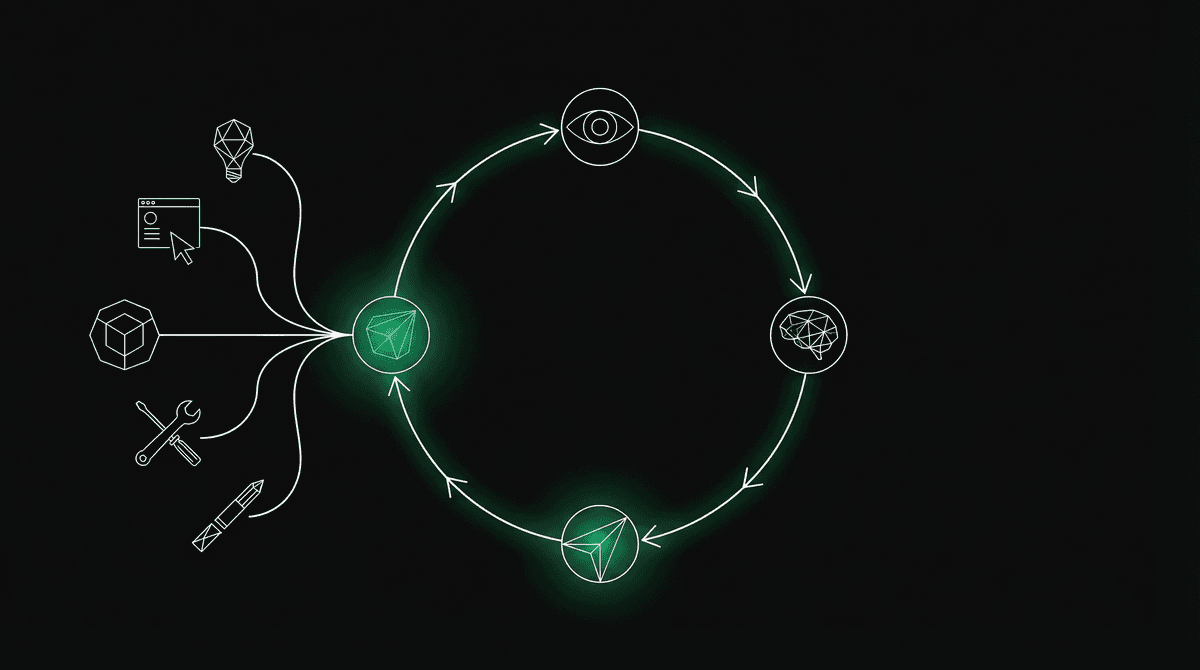
An agent is a loop:
OBSERVE  -> Read the current state (user message, tool results, environment)
THINK    -> Decide what to do next (generate text, call a tool, or stop)
ACT      -> Execute the action (call the tool, send the message)
OBSERVE  -> Read the result of the action
THINK    -> Decide what to do next based on the new state
ACT      -> ...
(repeat until the task is complete)
The loop is the defining feature. The agent keeps going until it decides it's done. It doesn't wait for the user between steps. It chains actions autonomously.
A chatbot answers a question and stops. An agent researches the question, pulls data from three sources, cross-references the results, writes a summary, and delivers it. Same LLM underneath. Different architecture on top.
The Four Components
Every agent, regardless of framework, has four components:
1. The Brain (LLM)
The LLM decides what to do at each step. It reads the current state — the original task, previous actions, tool results — and outputs either:
- A text response (task complete, deliver result to user)
- A tool call (need more information or need to take an action)
- A plan update (revise the approach based on what was learned)
The LLM's quality directly determines the agent's quality. A weak LLM makes bad decisions about which tools to call, in what order, with what parameters. A strong LLM chains 10 actions flawlessly.
This is why agent capability jumped when GPT-4 and Claude Sonnet/Opus arrived. The planning and decision-making improved dramatically over GPT-3.5.
2. The Hands (Tools)
Tools are functions the agent can call. Each tool has:
- A name (what it's called)
- A description (when to use it — the LLM reads this to decide)
- Parameters (what inputs it needs)
- Return value (what it gives back)
Common tool categories:
- Information retrieval: Search the web, query a database, read a file, call an API
- Actions: Send an email, book an appointment, create a file, deploy code
- Computation: Run code, calculate, analyze data
- Communication: Send a message, make an API request, post to social media
3. The Memory
Agents need memory across the loop iterations. Three types:
Short-term memory (context window): The LLM's context contains the conversation so far — all observations, thoughts, and actions. This is automatic but limited by context window size.
Working memory (scratchpad): Some agents maintain a structured "scratchpad" — a running summary of what they've done, what they've learned, and what's left to do. This is more compact than full conversation history and helps the LLM stay on track during long tasks.
Long-term memory (persistent storage): Information that persists across conversations. Files, databases, vector stores. The agent writes to persistent storage during one session and reads from it in the next.
Memory architecture determines whether an agent can handle a 5-step task (short-term is enough) or a 50-step task (needs working memory and possibly long-term storage).
4. The Planning
Advanced agents don't just react step-by-step. They plan.
Reactive agent: "User asked X. I'll try tool A. Got result. I'll try tool B. Got result. Done."
Planning agent: "User asked X. To answer this, I need data from sources A, B, and C. I'll query A and B in parallel, then use those results to formulate a targeted query for C. If C returns nothing, I'll fall back to source D."
Planning means the agent thinks about the sequence of actions before starting. It creates a multi-step plan and executes it, revising the plan when steps fail or return unexpected results.
Planning is what makes agents feel intelligent. Without it, an agent bumbles through a task, trying things randomly. With it, the agent moves purposefully toward a goal.
What Most "Agents" Actually Are
Most things called "agents" today are one of three patterns:
Pattern 1: Single-Tool Chatbot
User: "What's the weather in Rajkot?"
LLM: [calls get_weather("Rajkot")]
System: {"temperature": 34, "condition": "sunny"}
LLM: "It's 34 degrees and sunny in Rajkot."
One tool call. One response. This is a chatbot with a tool, not an agent. It's useful but it's not the agent loop.
Pattern 2: Multi-Step Reactive Chain
User: "Reschedule my appointment to Thursday and send me a confirmation."
LLM: [calls get_appointments("user_123")]
System: {"appointment": "Mar 22, 10 AM, Dr. Mehta"}
LLM: [calls reschedule("user_123", "Mar 27", "10:00")]
System: {"confirmed": true}
LLM: [calls send_sms("+91-9876543210", "Rescheduled to Mar 27, 10 AM")]
System: {"sent": true}
LLM: "Done. Your appointment is rescheduled to Thursday March 27 at 10 AM. Confirmation sent via SMS."
Three tool calls chained. Each decision depends on the previous result. This is a legitimate agent pattern — the loop, the tools, the decision-making. Simple, but real.
Pattern 3: Planning Agent
User: "Research voice AI companies in India and draft a competitive analysis."

LLM (planning):
  Plan:
  1. Search for Indian voice AI startups
  2. Search for voice AI companies operating in India
  3. Find recent funding rounds in Indian voice AI
  4. For each company, find their tech stack and target market
  5. Cross-reference with global players (Vapi, Retell, Bland)
  6. Draft competitive analysis

LLM: [calls web_search("Indian voice AI startups 2025 2026")]
System: {results: [...]}
LLM: [calls web_search("voice AI companies India healthcare")]
System: {results: [...]}
LLM: [calls web_search("ConversAI Labs funding")]
System: {results: [...]}
LLM: [refines plan based on findings, calls more tools...]
...
LLM: [writes competitive analysis document]
Multiple searches, plan revision mid-execution, synthesis of results into a deliverable. This is a full agent — planning, acting, observing, replanning.
Why Agents Are Hard
The Compounding Error Problem
Each step in the agent loop is a decision. Each decision has some probability of being wrong. If each step has 90% accuracy and the task requires 10 steps:
0.9^10 = 0.35 = 35% chance of completing the task correctly
65% chance that at least one step goes wrong. And one wrong step can derail the entire chain — querying the wrong database, passing a wrong parameter, misinterpreting a result.
The Cost Problem
Every step in the loop is an LLM call. Every LLM call costs money. A 10-step agent task that processes 5,000 context tokens per step:
10 steps x 5,000 input tokens x $0.003/1K = $0.15
+ 10 steps x 500 output tokens x $0.015/1K = $0.075
Total: ~$0.22 per task
At 1,000 tasks per day, that's $220/day. With a reasoning model (o1), multiply by 10-50x.
The cost of agents is not the LLM call. It's the loop multiplier. Every additional step multiplies the base cost.
The Latency Problem
Each loop iteration takes 1-3 seconds (LLM inference + tool execution). A 10-step task takes 10-30 seconds. A 30-step task takes 1-2 minutes.
For real-time applications (voice AI, chat), this latency is unacceptable. The user is waiting. Solutions:
- Streaming partial results (show progress as the agent works)
- Parallel tool calls (reduce sequential steps)
- Background execution (agent works asynchronously, notifies when done)
- Faster models (GPT-4o-mini, Claude Haiku for routine steps)
The Honest Assessment
Agents are the most hyped concept in AI right now. Every startup claims to be building one. Most are building chatbots with tool calling.
Real agents — ones that autonomously complete multi-step tasks reliably — are genuinely useful but genuinely hard. The compounding error problem means they need excellent LLMs, careful tool design, and robust error handling.
Next post: How agent frameworks actually differ. LangGraph, CrewAI, Claude Code — same concept, very different architectures. When to use which.